
The cost of must-have sports rights keeps climbing, forcing media companies to make harder choices about what else they can afford. Fox’s decision to hold onto its current NFL deal through 2029 offers a window into that growing pressure.
Fox Corp. CEO Lachlan Murdoch said during the company’s recent earnings call earlier this month that Fox would maintain its existing NFL deal and pricing through the 2029 season rather than renegotiate early. The company’s agreement runs through 2033, with the NFL holding a one-time right to terminate the deal after the 2029 season, covering the 2030 through 2033 seasons. Murdoch said Fox had held “thorough and productive discussions” with the league before deciding against amending its agreement.
The potential price of an extension helps explain Fox’s decision to wait. Based on the roughly 50% increase the NFL has reportedly sought in other rights talks, a similar jump in Fox’s annual NFL spending would amount to roughly another $1.1 billion per year, according to an analysis from Ampere. Ampere estimates Fox will spend roughly $7 billion on all content in 2026, including about $4 billion on sports. Another $1.1 billion for the NFL alone would represent roughly a 15% increase in the company’s total content spending.
Fox’s decision puts off that financial reckoning, but it doesn’t make it go away. The company can preserve the economics of its current deal through 2029, when the NFL can opt out, but it may eventually have to decide how much more it is willing to pay for a property that remains central to its business.
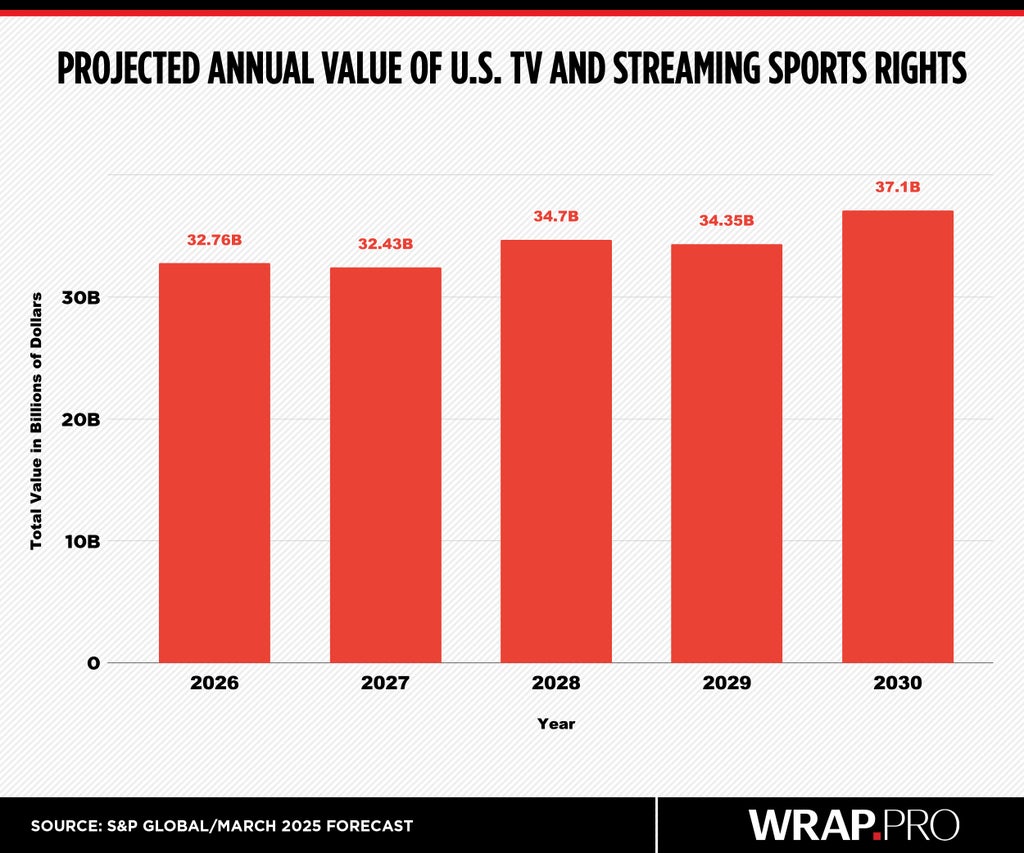
That kind of increase could have implications well beyond Fox’s sports budget, highlighting the dilemma all media players face. As TheWrap documented in its 2025 “Game On” series, sports-rights spending had grown five times faster than overall TV-industry revenue over the previous decade. The dynamic squeezes media companies trying to exercise greater discipline over programming costs — with marquee sports the one thing they can’t ignore.
“If a broadcaster has to pay $3 billion annually for the NFL, they might tend to pass on less expensive competitions,” Ampere analyst Sam Nursall told TheWrap.
For Fox, however, walking away from the NFL would be extremely difficult. “I’m hard-pressed to imagine a world where Fox does not have NFL rights,” Nursall said.
Fox Sports declined to comment beyond the company’s recent earnings remarks.
The $1 billion tradeoff
This isn’t just a Fox problem. U.S. broadcasters will spend roughly $36.5 billion on sports rights in 2026, according to Ampere, up 75% from about $20.8 billion in 2021.
Much of that increase has come from the biggest leagues entering new rights cycles. Annual NFL rights fees increased from roughly $7.7 billion in the 2022-23 season to $12.4 billion in 2023-24, while the NBA’s new agreements increased its annual rights haul from $2.7 billion to $6.8 billion beginning with the 2025-26 season, according to Ampere.

That doesn’t mean every sports league will benefit from the increased spending, as networks become more selective about where they’re investing those dollars.
“All companies are getting more disciplined around their sports rights spend,” said Daniel Cohen, executive vice president of Octagon Media Rights Consulting.
But that discipline isn’t distributed evenly, with the NFL a key exception.
“The NFL is a need-to-have for many, and a want-to-have for all,” Cohen said.
Why Fox can afford to wait
For Fox, the choice is between locking in greater certainty about its NFL future now and preserving the favorable economics of the deal it already has.
Renegotiating early could secure Fox’s NFL rights beyond the league’s 2030 opt-out window and remove the risk of having to negotiate later in a potentially more competitive market. Waiting, however, allows Fox to keep its current pricing through 2029 and see how the market — including the number and appetite of potential bidders — develops before committing to higher fees.

For now, Fox’s existing package appears to work economically. Octagon’s media rights group estimates the package is around break-even to slightly profitable on a direct basis after amortizing the advertising lift from its Super Bowl broadcasts. Fox pays roughly $2.03 billion annually in NFL rights fees, according to Octagon. When production and talent costs are added, Cohen said those expenses are offset by NFL-related advertising and transmission revenue.
But that calculation doesn’t capture what Cohen called the NFL’s broader “ecosystem benefit” to Fox, including local and national advertising, digital advertising, retransmission revenue, sponsorships, programming surrounding NFL games and potential benefits to businesses including Fox One and Tubi.
The value can’t be measured solely by subtracting the cost of Sunday afternoon football from the advertising sold against it. NFL programming also strengthens Fox’s position with distributors and supports economics elsewhere across the company.
What gets squeezed?
A roughly 50% increase in an early renegotiation would have translated to about $1.1 billion in additional annual NFL costs, according to Ampere — more than a quarter of the roughly $4 billion the firm estimates Fox currently spends on sports. That doesn’t mean Fox would cut an equivalent amount elsewhere; the company could generate additional revenue, absorb lower margins or adjust a content budget that could look very different by the time another NFL agreement takes effect.
As TheWrap previously reported, a major increase in NFL rights costs could put pressure on entertainment programming, smaller leagues and consumers. The new wrinkle is what that pressure could do to the structure of the sports-rights market itself.
Nursall expects greater spending on the most valuable properties to create opportunities for midsized buyers further down the market as the largest companies become more selective. He pointed to Versant’s post-NBC spinoff sports strategy, which has included rights to the new Pac-12 — which lost marquee schools including USC and UCLA to other conferences — along with the WNBA, League One Volleyball and Bundesliga, as an example of the opportunities that can emerge for other buyers.
The effect could be a more stratified market: intense competition for the relatively small number of properties capable of consistently delivering mass audiences, accompanied by greater price discipline for everything below them.

More buyers, but not for everything
Deep-pocketed technology companies have helped expand the pool of buyers for top-tier sports. Amazon became a major NFL partner with “Thursday Night Football,” while Netflix has acquired NFL Christmas games and YouTube has become an important distribution partner through its YouTube TV service. Nursall said the arrival of tech-native streaming companies has increased demand and helped push rights prices higher.
But the size of Big Tech’s balance sheets doesn’t mean every sports property can count on a technology bidder. Sports are central to the businesses of companies like Fox in a way they aren’t for Amazon or Google, which have many other places to deploy capital.
Cohen pointed to the artificial intelligence spending race as one competing priority. “Spending discipline is hitting the tech giants in a big way and Fox knows this,” he said.
If the choice is between buying more graphics cards to power a data center or rights to a second-tier sports property, the data center may win.
That leaves an important distinction between the very top of the sports market and everything below it. Amazon, Google or Netflix can add competition for premium rights, but if traditional broadcasters become more selective about less essential properties, tech companies won’t necessarily replace that spending.
“The most important factor in sports media negotiations is the simple need for there to be more bidders than there are rights for,” Cohen said.
The market splitting in two
Fox’s refusal to renegotiate early may say less about what the NFL is worth than about where the broader sports-rights business is heading.
The company has little reason to surrender the favorable economics of its current agreement today, but that doesn’t mean it won’t ultimately pay more. As Nursall noted, Fox could still reach a new agreement before the NFL’s 2030 opt-out window.
Whenever that negotiation happens, the consequences could extend well beyond Sunday afternoons. Fox and its peers may continue paying increasingly large sums for the properties they consider essential while becoming more selective elsewhere, potentially leaving less valuable rights with a different and smaller universe of buyers.
Fox’s current NFL deal buys the company time before it has to confront that tradeoff. The larger question for the sports business is what gets sacrificed as must-have rights keep getting more expensive.
