
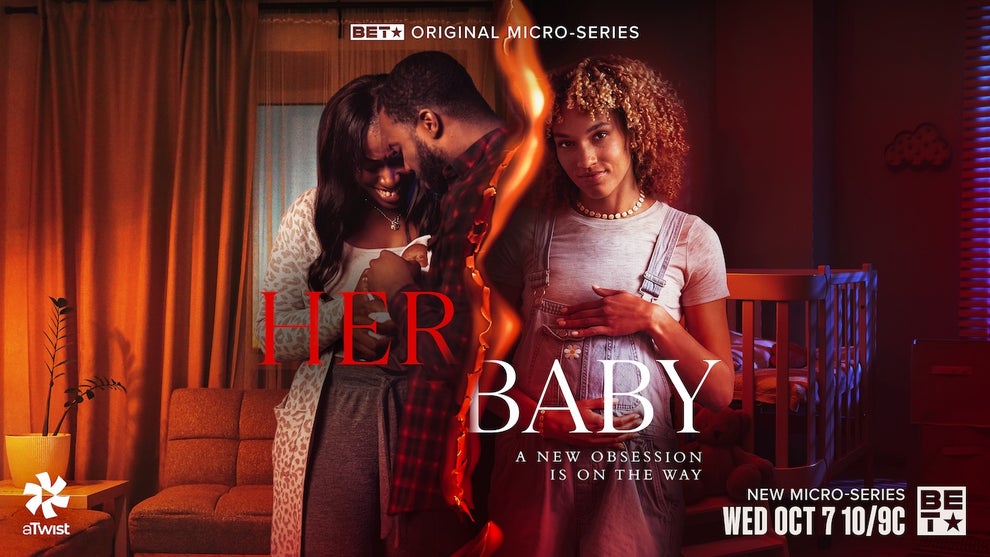
BET’s first microseries will debut on the network this October.
Psychological thriller series “Her Baby” will premiere first on BET in four half-hour installments as a horizontal format and will later be reformatted into a microseries for aTwist. This collaboration is a first of its kind.
“Her Baby” follows Naomi and Cory Marsh as they prepare to welcome their child with the help of Imani, their surrogate. Imani starts as a warm, devoted extended member of the family as she moves in to help with the child… until Naomi suspects that the woman carrying her baby wants far more than she’s letting on.
Mia Reese, Destyni Hannah Cooper and Brandon McGee star in the series, which premieres Wednesday, Oct. 7, on BET. A release date for the aTwist version has yet to be announced.

The BET-aTwist partnership will see the two platforms develop microseries that are designed to be viewed across multiple platforms. BET will have a limited first-run window for the long-form versions of the episodes before they are re-edited as microdramas for aTwist’s mobile-first viewing.
“The microseries format represents one of the most significant shifts in how content is created, distributed and consumed, and we’re positioning BET at the forefront of that evolution,” Aisha Summers-Burke, EVP and head of creative at BET Studios, said in a statement. “Our partnership with aTwist brings a best-in-class team and a format built for the future. Together we’re creating a pipeline that reflects Black culture and drives the conversation.”
aTwist’s model follows a more traditional television playbook. This model largely stems from the founders’ extensive experience in traditional entertainment — Jana Winograde formerly served as president of Showtime, Susan Rovner was formerly chairman of NBCU content and president of Warner Bros. TV and Lloyd Braun served as chairman of ABC Entertainment Group, studio and network and chairman of WME.
“Her Baby” is the first microseries from this collaboration, but the partners plan to work on more programming that serves Black audiences, a demographic that has remained largely underserved within the emerging microdrama ecosystem.
