A lot is riding on “Avatar: Seven Havens.” It has been over 20 years since creators Michael Dante DiMartino and Bryan Konietzko introduced us to the rich element-bending world of “Avatar: The Last Airbender,” which first premiered on Nickelodeon and eventually cemented its place as one of the greatest animated series of our time. Aside from the “Avatar Aang” film released to Paramount+ earlier this year, it’s been a long 12 years since the universe has progressed forward. At long last, “Seven Havens” brings us a new Avatar, and in some ways, a completely new take on the franchise.
Based on the first six episodes provided to critics, “Seven Havens” is a marvel. There are some kinks that take a few episodes to warm up to, like a more childish-than-expected tone and some flat animation — but they hardly detract from the series’ compelling stories, immediately affable characters, and world-building so rich it is a resounding reminder why this universe is so special and worthy of acclaim.
“Seven Havens” takes place 225 years after “The Legend of Korra,” and introduces a new world order. Benders and non-benders alike now believe that Korra, the last Avatar tasked with maintaining balance between the four nations, went berserk and caused a world-ending cataclysm that has effectively caused a climate change apocalypse. Gone are the days of Ba Sing Se and the technological revolution of Republic City; the population now resides in seven fortified mixed-bending “havens” that protect them from turbulent storms and unpredictable weather patterns.

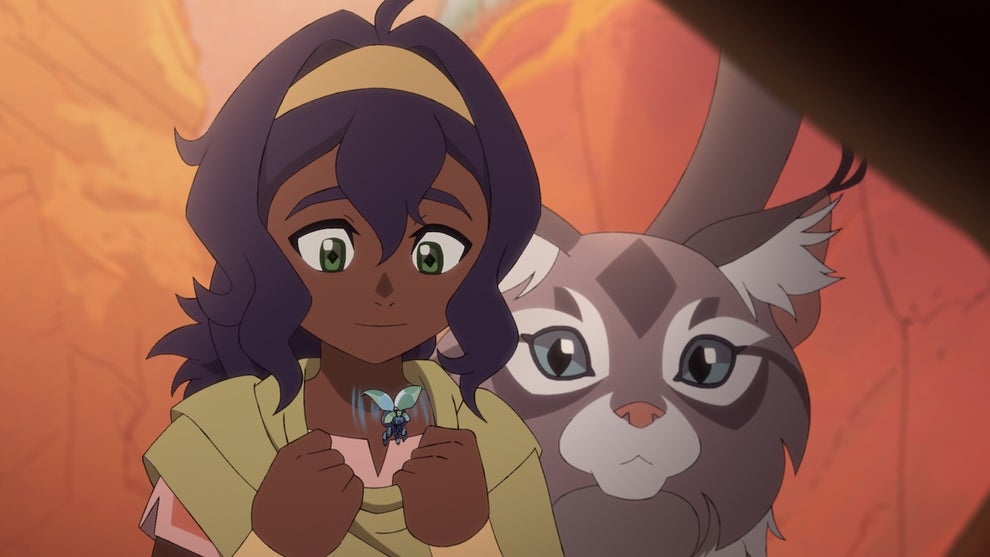
This time around, our protagonist is Pavi (Saheli Khan), a young earthbender with a self-fashioned wooden prosthetic outfitted to replace the leg she lost. With little memory of her childhood, she’s made new friends in bugs and rocks while sneaking around the stronghold of Ellora with her cat monkey companion Geet (Dee Bradley Baker, who voiced Appa and Momo). Pavi can bend all four elements somewhat effortlessly but has little interest in sharing that with anyone, since a new Avatar would not be welcomed warmly in this society — which is why she hides in a cave outside the city’s walls.
Eventually, Pavi meets her long-lost twin sister Nisha (Aishu Devan), who’s also an earthbender but with a less whimsical, tough exterior. Together, they have a lot to figure out: Why they were separated, who their parents are, and why they struggle to remember much about their life pre-Ellora. An embargo prevents us from revealing a major twist related to Pavi and Nisha, but let’s just say their connection very much complicates the role of the Avatar.
Rounding out the trio is Jae (Major Curda), an airbender who’s part of the Brigade at Ellora, a bending militia conscripted at a young age to train and defend the city. We find out there are fewer and fewer benders born each year, so the Brigade is stretched thin.
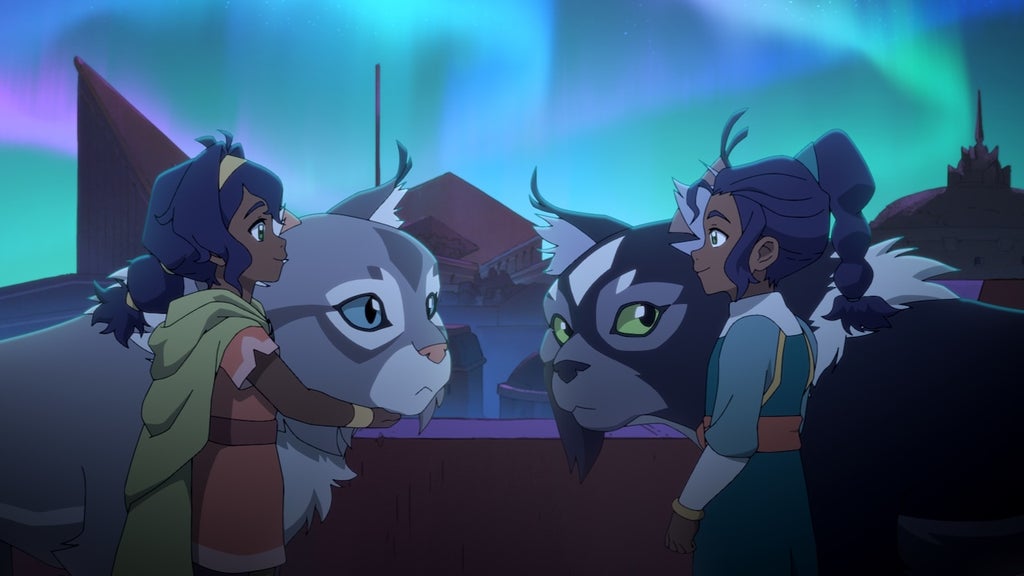
Jae’s pre-conceived ideas around the Avatar are put to the test when he meets Pavi. Considering the “little Earthbender” (as he calls her) is charming and would protect even a bug from harm, she might not be the destructive monster he or the citizens of Ellora imagined.
The biggest concern for fans going into “Seven Havens” after the teaser release was the animation style. Admittedly, it does take a bit of getting used to. There is simply less detail here than “Korra” — fewer shadows and facial details, and some fairly simplistic movement, whether or not that’s due to a lower budget or a rushed production timeline.
Outside of those comparisons, what we have here is still very beautiful to look at — the skies are permanently in a state of colorful auroras and the shards of crystals contrasted against the stark deserts of “the harshlands” that surround Ellora are inspired by the French surrealist artist Mœbius. It’s easy enough to appreciate the art style on its own merit, even if the quality looks closer to the first season of “The Last Airbender” than the breathtaking animation of the “Avatar Aang” film.

Besides, the more we find out about Ellora and the universe of “Seven Havens,” the less the faults in the animation seem to matter. There is a lot going on in this new series, but it never feels convoluted or overly complex. It is of course a serialized format, but episodes feel distinctly structured. Most episodes layer onto an already-captivating mystery, while slowly drip-feeding the viewer with everything from “The Last Airbender” easter eggs to answers about what might have happened with Korra’s alleged world-ending destruction.
In this way, every episode introduces a new facet to the season-long arcs: A foreboding spiritual disturbance haunting the city, a group of raiders causing havoc, benders being kidnapped. Even through the seemingly insurmountable obstacles, there is a sense of whimsy and playfulness that feels only right in the “Avatar” universe, and it’s easy to fall in love with our lead trio and extraneous characters like Karthik (Akshay Khanna), the captain of the Brigade who ends up serving as an Uncle Iroh-style mentor and one of the few characters with a direct connection to the lore of the original series.
It is also worth noting not only do we have a predominantly Asian voice acting cast, but an Asian writing team as well led by head writer Sehaj Sethi. This was a major flaw of the first two series. Despite “Avatar” being a fictional universe, it pulls deeply from Asian and Indigenous aesthetics, martial arts, and mythology — it feels right for DiMartino and Konietzko to recognize the importance of a representative creative team in this way.
Finally, “Seven Havens” sounds incredible. Jeremy Zuckerman returns once again to craft the score and what he creates pulls the series together with synths and sounds of East Asian influence, while occasionally mixing in nostalgic harmonies that evoke all the best nostalgia. It is Zuckerman’s best work yet, and perhaps one of the best scores on television.
After the “Avatar Aang” movie and the poorly-received live-action adaptations, it feels like “Seven Havens” is getting back to the basics, in the animated episodic format where it thrived in the first place. These are six engrossing, rich and entertaining episodes — a great sign of what’s to come for the future of “Avatar,” and a veritable treat for the fans who have been waiting so patiently.
“Avatar: Seven Havens” releases new episodes Fridays on Paramount+.