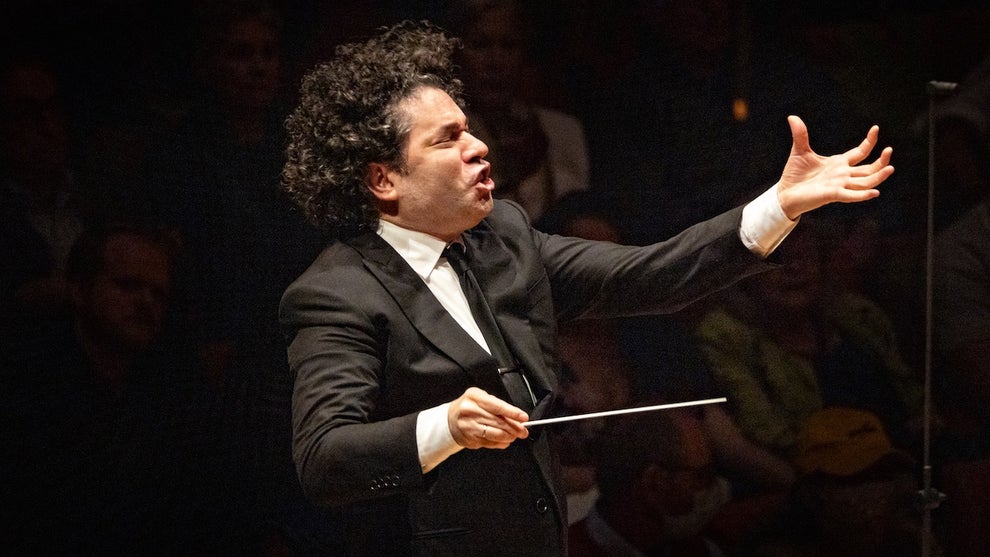
On Thursday night, Gustavo Dudamel will stand in front of the Los Angeles Philharmonic for the first of his final four concerts as music and artistic director of that magnificent orchestra. Before he heads east to become artistic director of the New York Philharmonic, Dudamel will lead a Hollywood Bowl concert that includes not only Beethoven’s titanic 9th Symphony, but the world premiere of “Hymns of the Heart” from Michael Giacchino.
And that juxtaposition – a little of the old Ludwig Van and a new work from the film composer best known for his music for “The Incredibles,” “Up,” “Star Trek,” “Jurassic World” and three “Spider-Man” films – encapsulates the wholly remarkable Gustavo Dudamel, a Venezuelan conductor whose vision of music sees no barriers between European concert classics and Hollywood movie music, or between any other kinds of music that can excite and inspire people.
And it helps explain why Los Angeles, and also Hollywood, will miss him so much when he heads to Lincoln Center. “I hope people realize what it’s meant for Los Angeles to have had him for all these years, and what it’s going to mean for New York,” Giacchino told TheWrap this week. “And I hope New York has fun with him, because we certainly did.”
Yes, we did. Over the course of his tenure, the LA Phil cemented its reputation as perhaps the finest and most adventurous major orchestra in the United States; they were already in the thick of that conversation under previous music director Esa-Pekka Salonen, but when Dudamel arrived, still in his 20s, he brought a sense of unbridled joy.

(If you think about it, it’s no wonder that like Thursday’s program, his first Hollywood Bowl concert as music director in 2009 also included Beethoven’s 9th, which ends with the “Ode to Joy.”)
As a regular visitor to the LA Phil’s regular home in Disney Hall, I’ve long felt that the best seats for orchestral concerts conducted by Dudamel are the ones behind the stage, where you can follow his facial expressions. Even in a piece as somber as, say, Mahler’s 9th, there’s a sense of playfulness and delight as he cues an entrance here, a flourish there.
It rarely feels like a performance the way some composers’ histrionics sometimes do; it’s more like a private connection between Dudamel and his musicians as they skillfully navigate music both comfortable and challenging.
It has helped make him one of the most impactful members of a line of LA Phil music directors that includes such notables as Salonen, Otto Klemperer, Zubin Mehta and Carlo Maria Giulini. And he has done it not by sticking to the standard classical repertoire – though he’s a master at that –but by fashioning a boldly inclusive programming philosophy that includes lots of new music, lots of Central and South American music and lots of film music.
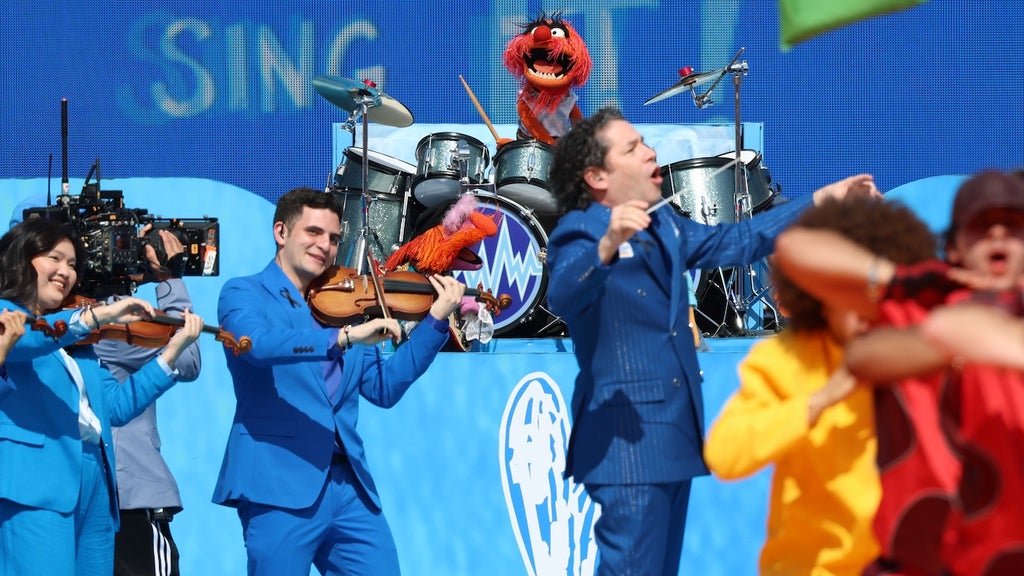
During his tenure in Los Angeles, Dudamel conducted on the Oscars, at Coachella and at the FIFA World Cup Final Halftime Show (with the Muppets, no less). His four Hollywood Bowl concerts this week, taking place over consecutive nights from Thursday through Sunday, will include a night in which he and the orchestra will accompany the Foo Fighters and two, including a benefit for Venezuelan earthquake victims, that will find him sharing the stage with an array of Latin American musicians, among them Lila Downs, Los Tigres del Norte, Natalia Lafourcade and Mariachi Reyna de Los Angeles.
“He doesn’t draw any lines between different types of music,” Giacchino said. “For him, it’s all about embracing the joy that you can find in all music.”
I learned as much the first time I met Dudamel, which came in 2013 at a Beverly Hills restaurant for an awards-season lunch in honor of “The Liberator,” a Venezuelan film that marked Dudamel’s entry into writing film music. When he mentioned that he was going from the restaurant to a rehearsal for concerts at Disney Hall later that week, I asked him what the orchestra was going to be playing. “Pictures at an Exhibition,” he said. “Mussorgsky.”
That piece had been one of my favorite classical compositions when I was a teenager, largely because the English progressive-rock band Emerson, Lake and Palmer had recorded their own bold and rather hamfisted rock ’n’ roll take on Modest Mussorgsky’s work. Of course, I wasn’t going to admit to this international maestro that ELP got me into the magnum opus of a Russian composer, so I just told him that the piece had been one of my favorites back when I was first exploring classical music.
He nodded and leaned forward across the table. “You know who else did a great version of it?” he asked with a grin. “Emerson, Lake and Palmer!”

And that’s Gustavo Dudamel. The man may have shaken up the world of classical music while still in his 20s, and he may have commanded the stages of the most hallowed orchestra halls in the world – but he doesn’t have a pretentious bone in his body, eagerly embracing the way a trio of British rockers bashed away at a late-19th-century Russian suite.
And just as eagerly, he embraced the world of film music so completely that he became only the second LA Phil music director with a star on the Hollywood Walk of Fame. (Zubin Mehta was the first.) John Williams is a close friend and mentor of his, offering advice when Dudamel ventured into writing his own film music. (One piece of Williams’ advice he remembered particularly: Once you get a good melody, you can write lots of variations and use them throughout the score.)
Apart from programming film music, the orchestra was also involved in a three-year collaboration with the Academy of Motion Picture Arts and Sciences, beginning in 2016. The first year, the LA Phil held three AMPAS-sponsored concerts performing the scores to “Rebel Without a Cause,” “On the Waterfront” and “Casablanca.” The next year, they and the Academy presented three riveting concerts devoted to the work of or favorite selections chosen by film composers Hildur Guðnadóttir, Kris Bowers and Nicholas Britell. The third year, Dudamel and the orchestra appeared live on the Oscars show, performing a Williams selection during the In Memoriam.
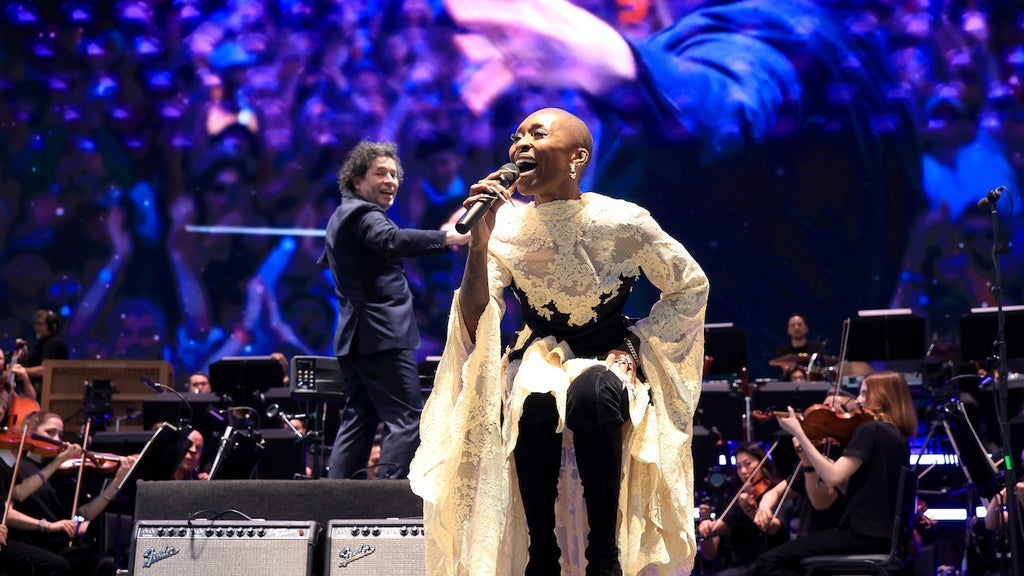
Later, Dudamel recorded the music for Steven Spielberg’s version of “West Side Story” with both the L.A. and New York Philharmonics. He even led the world premiere of “Marvel’s Infinity Saga Concert Experience” at the Hollywood Bowl, a first-ever event for Marvel that found Dudamel walking onstage wearing the Infinity Gauntlet on his left hand and a conducting with purported Vibranium baton that Marvel chief Kevin Feige presented to him.
Giacchino met Dudamel as they worked on that Marvel event in 2024, and the seeds for Thursday’s concert were planted over dinner after the concert. “He said, ‘I’m going to be leaving in a couple of years, and we’ll be doing a week of farewell concerts at the Bowl. Would you be interested in writing something?’” Giacchino said, and then laughed. “I immediately said, ‘Absolutely!’ And then I got home and thought, ‘What have I gotten myself into?’”
But the composer found his inspiration in the man who’d commissioned the work. He asked poet Amanda Gorman to write a libretto, brought in the Los Angeles Children’s Chorus and students from Education Through Music and wrote a piece that celebrated the childhood enthusiasm that people are sometimes taught to grow out of.
“He has a sense of fun in everything he does,” Giacchino said. “I wanted to celebrate the idea of how great it is to make noise, because that’s what I see in him.”
We won’t see that as often in these parts with Dudamel’s departure, although he’ll be back (more Beethoven in December, Stravinsky in May!), and incoming music director Daniel Handler will no doubt make a case for himself.
And in the meantime, we’ve got the music and the memories. I think back to TheWrap’s screening of “The Liberator,” which took place at a theater in Westwood a couple of days after that lunch where Dudamel and I had shared our affection for Emerson, Lake and Palmer.
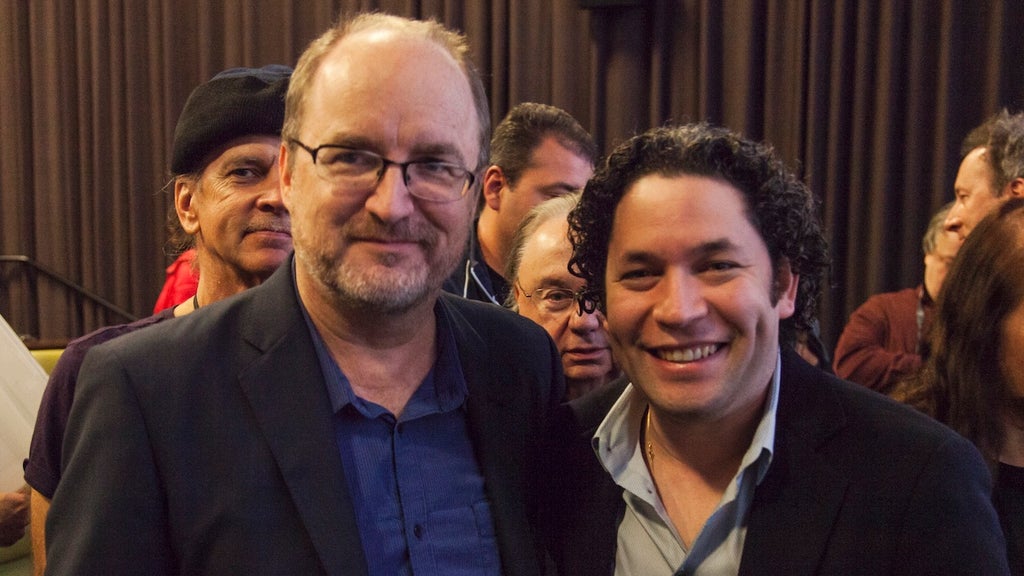
The conductor-turned-composer was part of a conversation I moderated with seven different people from the film – more than we’d expected, as we’d only set up seven chairs for the panel and moderator. To make room for everybody, I gave up my own seat and stood at one end of the group until an usher showed up with an eighth chair – whereupon Dudamel, at the far end of the group from me, took the new chair from the usher and carried it across the front of the theater to me.
As I said that night, the man is a full-service maestro. Los Angeles – and Hollywood – will miss him.
Have fun, New York.
