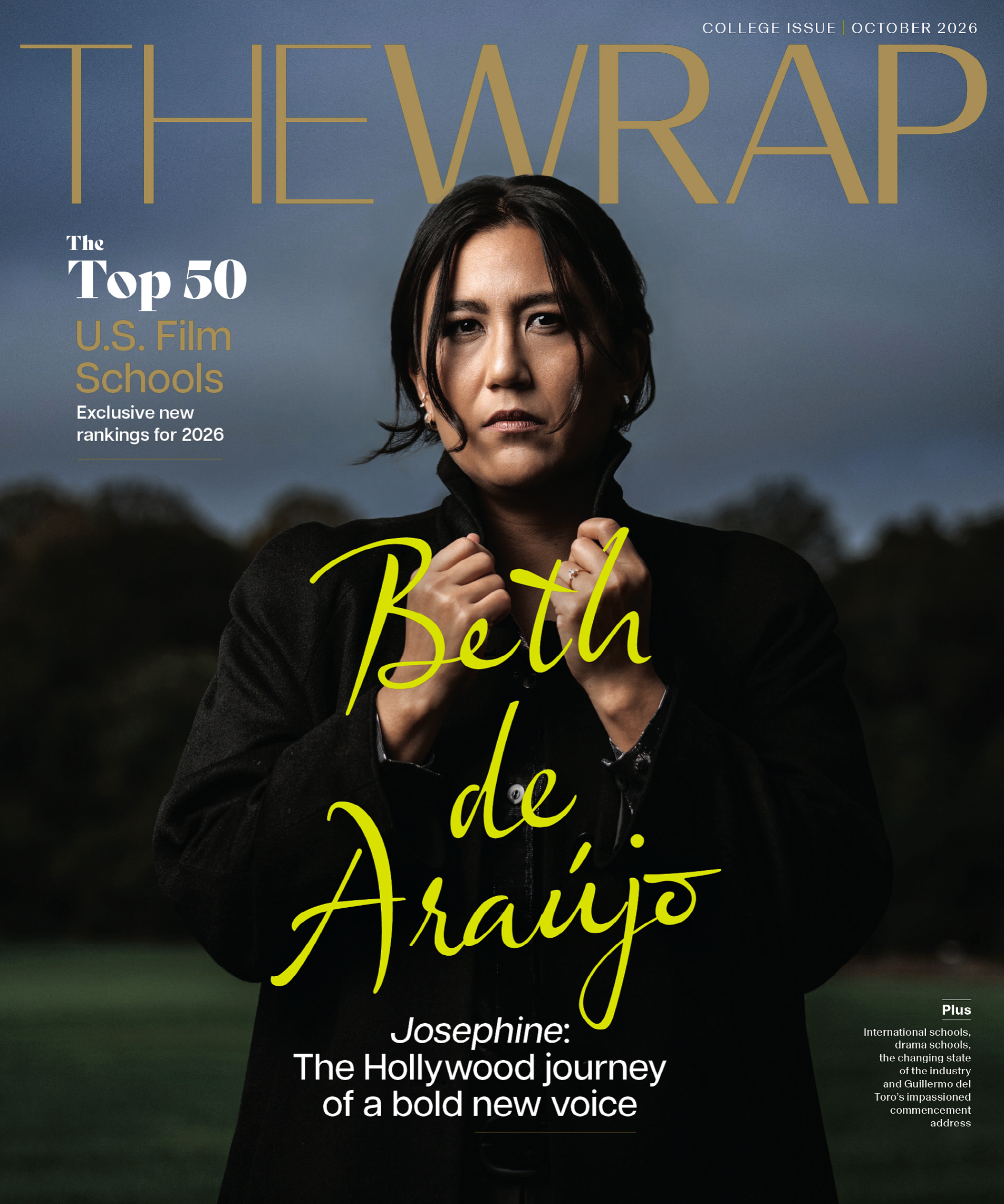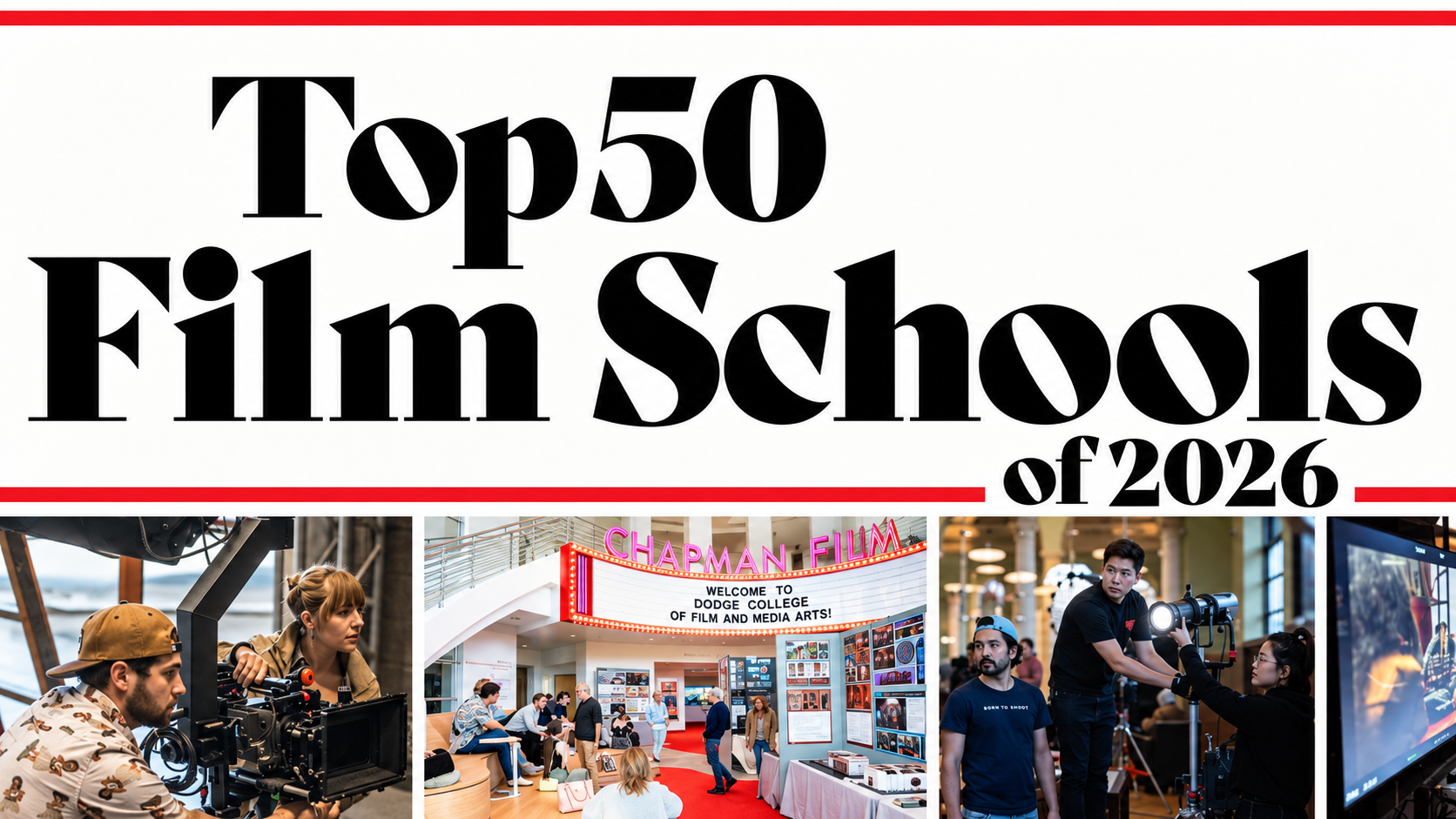
TheWrap’s 11th annual ranking of the best U.S. film schools marks our third partnership with the research company Screen Engine/ASI, which implemented a data-driven system. Kevin Goetz’s company created a comprehensive survey and used the answers to score each institution on a wide variety of factors. A more detailed explanation of the methodology is available at the end of the rankings.
While Hollywood may be in a time of turmoil, these rankings have remained stable over the past three years, with NYU retaining its No. 1 position and 38 of the 51 schools (due to one tie) landing within four places of their 2025 ranking. SCAD broke into the top 10 and DePaul into the Top 15; Rochester Institute of Technology, Cal State Northridge and American University all had big gains; and six schools made the list this year after being unranked last year: the University of Wisconsin—Milwaukee, UC Santa Barbara, the Ohio State University, Brooklyn College, Asbury University and the Community College of Aurora.
Overall, we noted that schools are investing heavily in production facilities, moving toward a technology-enabled, cross-platform film education that combines upgraded physical production infrastructure with virtual production tools, AI and broader media formats. Curricula are also broadening beyond traditional filmmaking, reflecting an entertainment industry in flux.


50. Community College
of Aurora
Department of Cinematic Arts
Aurora and Denver, CO
CCA has the enviable distinction of being the only community college to make these rankings. It boasts that it provides the “highest value” film school experience anywhere, based on its combination of low tuition ($4.2K in-state, $17.8K out-of-state) and facilities that can match many four-year schools’. There are two-year AA degree tracks in Directing, Cinematography, Post-Production, Producing, Acting and Screenwriting. All students take a foundation of core courses the first semester before specializing later on. CCA underscores professional development with hands-on technical training, portfolio building and exposure to networking opportunities before graduation.
49. Asbury U
Media Communication: Film
Wilmore, KY
A newcomer to the list this year, Asbury is a small (1,700 undergraduates, 300 graduate students) Christian school located about 15 miles outside Lexington, Kentucky. Despite its size, it has three studio/sound stages, two large backlots, two volume walls and ARRI camera equipment. Major studios rent the stages in the summer, employing Asbury students as crew members. This past summer, 21 of them worked on “Cat Enright: The Opium Equation,” a feature-film adaptation of the book that shot around Lexington. It also showcases one of the largest collections of film art — more than 12,000 sketches — and 1,000 props in an on-campus film museum. The film program enrolls about 52 undergraduates and 56 graduate students, who can pursue a BA and an MA in film/TV production. Tuition is $33K for undergraduates and $9,600 for graduate students.
48. Brooklyn College
Feirstein Graduate School of Cinema
Brooklyn, NY
Feirstein’s graduate conservatory program, which turned 10 in 2025, offers both MA and MFA programs. It’s housed at Steiner Studios’ working Brooklyn lot and made a deal with Blackmagic to supply cameras — all in service of its hands-on ethos. Debuting this year: a course on producing taught by True Detective’s Richard Brown. But in general, it didn’t provide ample information about facilities, alumni and extra programming on TheWrap and ScreenEngine’s questionnaire. The highly selective program — just one in four applicants gets admitted — enrolls 220. Student satisfaction and completion rates are outstanding: 94% retention and 95% graduation.
47. Belmont University
Mike Curb College of Entertainment & Music Busines
Nashville, TN
The film college at this Christian university makes full use of Nashville’s growing production market — there’s a reason David Ellison chose the city as Paramount’s potential new home if the Warner Bros. deal fell through — and its historically great music scene. Belmont’s entertainment-oriented business school is also well-regarded. The school takes advantage of the music connection, which allowed it to work with and teach Dolby Atmos, generating the first dozen or so student films to be mixed in the audio technology. A big boost came with the recent $58 million donation from music executive Mike Curb, earmarked fully for the entertainment college. The school didn’t provide graduation or retention statistics, but the $45K tuition makes it one of the most affordable private schools on the list.
46. Rhode Island
School of Design
Providence, RI
With alumni ranging from Talking Heads founder David Byrne to Seth MacFarlane and Gus Van Sant, RISD lives up to its reputation as a legendarily creative and bohemian school. Animation has always been one of its strong suits, but recently, it added the interdisciplinary Movement Lab, partly funded by a donation from Muppets heir Cheryl Henson. This year, it also introduced a live-action puppetry class. RISD didn’t provide stats on retention or graduation rates, and it sits in the top quarter of the most expensive schools on the list, thanks to its $63K tuition.
45. The Ohio State University
Department of Theatre, Film, and Media Arts
Columbus, OH
The Moving-Image Production BA, which will celebrate its 10th anniversary next fall, was designed to complement an existing film-studies-only program. It focuses on production within a liberal-arts context and uses four approaches to filmmaking — narrative, documentary, experimental and animated — while requiring cross-disciplinary courses in areas like Fine Arts and English. The Wexner Center, OSU’s contemporary-arts hub, augments the classroom with about 200 screenings a year, from docs to indies to classics, and a steady stream of guest speakers. While OSU is huge (68K students), the film program is small (135 undergraduates). It considers that mix of intimacy and the resources of a major public research university one of its strengths, and a 95% retention rate bears that out.

44. Morehouse College
Cinema, Television and Emerging Media Studies
Atlanta, GA
Embracing its status as the Harvard of HBCUs, Morehouse places a unique emphasis on African American and global Black cinema studies, hiring new faculty specializing in African cinema. There’s also a partnership with the Academy’s Nicholl Screenwriting Fellowship to increase access beyond the public submission process. Morehouse lacks the equipment and facilities of some better-endowed programs, but it makes up for that with a rigorous program, an outstanding liberal-arts education and professional collaborations for the students within Atlanta’s robust production community. Those collaborations included making short films for the NBA’s Atlanta Hawks and working on another honoring Martin Luther King, Jr. (’48), which debuted on “CBS Mornings” with Gayle King. Recent alum David Fortune (“Color Book”) made Variety’s 2026 “Directors to Watch” list.

43. University of Georgia
Atlanta, GA
One of the newest programs on the list, Georgia’s “boutique” grad-only program (just 56 students) was founded in 2019 but holds 100% retention and 95% graduation rates. It just established merit-based scholarships for second-year students, and coming next academic year is a joint three-year MFA/MBA. Writer Marion Dayre (“Echoes”) and director David Fortune are two of the working professionals who recently joined the faculty. UGA highlights the school’s status as home of the Peabody Awards and its location in Athens, with a Music Video initiative to collaborate with and support the famously vibrant local music scene.

42. The Los Angeles Film School
Los Angeles, CA
The for-profit institution sees itself as the provider of a film education that “reflects the realities and demands of today’s creative workforce.” It focuses on practical professional development with working faculty, hands-on training and career-development support from Day 1. Its campus, which is anchored in the old RCA building on Sunset, features 250K square feet of classrooms, labs and production stages with industry-standard gear and software. With an enrollment of 5,472, LAFC is the largest school on the list, though more than half are enrolled in the online degree program. Tuition, which is calculated on a per-degree basis, is affordable: An eight-semester BS in film production, for example, will run about $11K per semester. The high number of online-only students and the lack of a traditional campus likely contribute to the school’s subpar retention (51%) and graduation (34%) rates.
41. Stanford University
Department of Art and Art History
Palo Alto, CA
Stanford’s reputation as the gold standard for aspiring documentarians is underscored by the fact that for seven years running, someone from the school has won a U.S. doc award at Sundance. The ultra-exclusive program — perhaps 1 in 20 applicants gets admitted — is becoming even more so by reducing the incoming class to just six students. “Doubling down on its founding bet,” it describes its strategy as “fewer filmmakers, more funding and more support for each artist.” And it is a generous bet: Admitted students are fully supported financially, even receiving a housing allowance to offset the insanely expensive Palo Alto. New courses this year include sound design and cinematography classes designed specifically for documentarians.

40. Full Sail University
Winter Park, FL
Full Sail says its campus, whose Hollywood-style backlot is just one part of its 880K square feet of production facilities, feels as much like being at a real studio as it does a school. New students are gifted with Project LaunchBox, containing a laptop, plus audio and film equipment. Full Sail looks to build community and cross-disciplinary collaboration among film, music, game and business students with initiatives like Hall of Fame Week, curated networking events and mixers. It works to extend that community to alumni with its “Come Back Anytime” initiative, allowing graduates to return and take a new course within their degree program, on an available-seating basis. Tuition runs at a relatively modest $32.6K, and the school boasts decent graduation and retention rates.

39. University of California,
Santa Barbara
Department of Film and Media Studies
Santa Barbara, CA
Founded in 1973, the long-standing program offers everything from BAs to PhDs and manages to keep up with the times with a new class on the broader impact of AI in entertainment (film, sports, video games). It also collaborates closely with the school’s Carsey-Wolf Center, a hotbed of new-media scholarship partly funded by the creators of “Roseanne” (Marcy Carsey) and “Law & Order” (Dick Wolf). The 480-student program, which has a first-to-second-year retention rate of 82%, counts screenwriter Scott Frank and studio exec Elizabeth Gabler among the alumni who’ve been known to say that UCSB taught them “how to think, not just how to make.” The school also boasts a newly minted Oscar winner following Andy Jurgensen’s victory for editing “One Battle After Another.”
38. Ithaca College
Roy H. Park School of Communications
Ithaca, NY
The nearly-60-year-old program renamed its major Television, Film and Digital Media to reflect both the convergence of TV and film and the rise of digital. Facilities improvements this year include new ARRI cameras for real-time mo-cap. Saw producer Dan Heffner (’78) helps fund two big opportunities: a producing award that allows a rising senior to produce another student’s film, and the Golden Doorknob, a horror-film competition that goes back to the program’s founding in 1969. In recent alumni news, Dylan Clark (’23) landed a deal to direct his first feature film, “Portrait of God,” based on a short he made as a student.

37. Arizona State University
The Sidney Poitier New American Film School
Tempe, AZ
Several things set the Poitier School apart from other programs, starting with its one-school/three-location setup that spans the main campus in Tempe, production facilities in Mesa and an L.A. semester outpost headed by Emmy winner Peter Murrieta that includes an MA program. Poitier is committed to inclusiveness, with more than 40% of its students coming from underrepresented backgrounds. Furthering that commitment, it is home to the Borderlands Cinematic Arts Lab, which supports mid-career Latino filmmakers. Its in-state tuition of $11.8K and out-of-state tuition of $34K make it more financially accessible than other institutions. With 784 students, Poitier is among the dozen largest in the rankings.

36. American University
School of Communication
Washington, DC
The 33-year-old program trumpets its “blended” approach of exposing students to a wide range of filmmaking disciplines and says its mix of experiential learning and deep mentorship distinguishes it from competitors. This year, the 87-student program added 2025 Amazon/Sundance Producer of the Year Joe Pirro to the faculty and brought in new Canon cameras, upgraded sound mixers and LED lighting to its equipment stock. It makes the most of its Washington, DC, location by leaning into nonfiction filmmaking — offering, for example, a fellowship to bridge the gap between film and investigative journalism. Tuition clocks in at $60K, but the program boasts an outstanding 90% graduation rate.
35. Rutgers University
Filmmaking at Mason Gross School of the Arts
New Brunswick, NJ
Rutgers’ differentiator is its Documentary Film Lab, a professional production unit led by Academy Award winner Thomas Lennon. The lab calls upon scientists, artists, community organizations and more to produce broadcast-quality nonfiction films, with students participating in every stage from research to post. Rutgers’ Collaborative Arts Grants give up to four interdisciplinary teams funding for projects that highlight the “interconnectedness” of disciplines. New Jersey’s flagship public university also sells its location, about an hour from NYC and even closer to Netflix’s Fort Lee studio and Lionsgate’s Newark studio, as an advantage. The school reported equipment upgrades this year, among them new Blackmagic cameras.
34. Ringling College of Art and Design
Sarasota, FL
If a hands-on practical education is your goal, Ringling is a strong choice. The 105 film majors crew on each other’s projects so that by graduation the average student has worked on 60 films. Game Art, Virtual Reality and a certificate in Virtual Production are a sampling of the school’s forward-looking majors. It has upped its doc offerings and introduced a certificate in Branded Entertainment across all majors. It also has an exchange program with Falmouth University, one of the UK’s top film schools. The $54K annual tuition is among the lowest of the private schools on the list.
33. Southern Methodist
University
Meadows School of the Arts
Dallas, TX
SMU combines the benefits of a smallish program (95 majors) with the fun and amenities of a large (12K total enrollment) first-rate private school in the kind of Southwestern, warm-weather location that has proved ever more attractive to students. The school accentuates its Summer Film Production program as something that sets it apart from other institutions. Every two years, it produces a full-length feature made completely by students from writing to post. Juniors and seniors take leadership roles, while first- and second-year students learn the ropes as crew members. In 15 years, SMU has made seven, and most are available on at least one streaming platform. Recently, SMU has also created a screenwriting track, which it has augmented with several new hires. The $63K tuition puts SMU in the top quarter.

32. University of Colorado
at Boulder
Cinema Studies & Moving Image Arts
Boulder, CO
January ushers in a new era to the decade-old program with the relocation to Boulder of the Sundance Film Festival, which will hold screenings at three campus venues. One immediate benefit: an overhaul of Muenzinger Auditorium, the school’s main screening space. For a second year, it’s also offering its Film Festivals Culture class, which will directly incorporate Sundance. The program has always shown a lot of love to celluloid and has now brought two classes, Analog Alternatives and Analog Alchemy, to the permanent curriculum. Students get the chance to shoot on Super 8, 16mm and 35mm film. New faculty and upgraded equipment enhance the school’s production side. While Sundance will bring Hollywood to Boulder, the university doesn’t have a remote study program allowing students to go to Hollywood. The program pitches that as a positive, underscoring that its faculty isn’t tied to the L.A. film scene but instead is driven purely by art.
31. Pratt Institute
Film/Video Department
Brooklyn, NY
With its pastoral campus, featuring a renowned sculpture garden, only a 20-minute subway ride from Manhattan, Pratt offers a location that few institutions can match. The program celebrates an active approach that supplies students with high-end gear so that they can complete 12 to 20 films by graduation, all in the context of a “super-creative interdisciplinary art school.” This year, Pratt upgraded its computers, finishing suites and sound-mix studio. It’s also working to address its retention (84%) and graduation (76%) rates in the 223-student program, holding monthly student government/administration meetings and starting a peer mentorship initiative that pairs new students with upperclassmen.
30. School of Visual Arts
New York, NY
The emphasis at this NYC-based for-profit school is on professional preparation. Students can pick up cameras as soon as they arrive, with SVA initiating partnerships with a range of equipment companies (Sony, Fuse, Panavision, Zeiss Lenses) and also adding eight Blackmagic PYXIS 6K cameras. SVA likes to say that filmmaking is a relationship business, and the school’s connections to established filmmakers are one of its big pluses. It says its faculty is composed of working professionals committed to helping students successfully transition into becoming pros themselves, while stressing the importance of collaboration. That’s exemplified by new hires like chair of the BFA film department Dejan Georgevich, a former national vice president of the International Cinematographers Guild, and Vince Misiano, a former national VP of the Directors Guild of America

29. Hofstra University
The Lawrence Herbert School of Communication
Hempstead, NY
The film program, which celebrated its 30th anniversary last year, is proudly “hands-on from Day 1” and balances small classes with real-world experiential learning in nearby NYC (or, for a semester, in L.A.) for its 313 students. To that end, it has invested in upgrading camera equipment and adding a new studio in the Brower Podcast Center, which will also provide video production options.

28. Drexel University
Antoinette Westphal College of Media Arts & Design
Philadelphia, PA
Drexel is notable for employing the increasingly popular co-op educational model that requires students to spend two terms (about six months) gaining hands-on experience. Drexel undergrads have co-oped at places ranging from studios (Marvel, Sony) to TV programs (“Law & Order: SVU,” “The Daily Show”) to networks (NBC, Syfy) to agencies (ICM). On campus, students can work on “Off Campus,” a sitcom in its 13th season made by students using professional actors, or Dragon Productions, which does video production for both university and outside clients. Drexel succeeds in fostering a community with small classes (16 for production, 12 for writing) and offering a full range of equipment and facilities, including mo-cap and the only local LED volume.

27. ArtCenter College of Design
Pasadena, CA
The film program aims to train “agile” filmmakers skilled in everything from narrative features to docs to advertisements to art installations. For example, new this year are a pair of classes on commercials and advertising. The program is practically oriented, with only about a fifth of the courses devoted to theory and history. Students start making movies in their first term, and both Panavision and Sony have donated state-of-the-art equipment for them to use. The school didn’t report enrollment numbers, but historically the program has been on the small side, numbering about 120 total undergrad and graduate students. Directors Michael Bay and Zack Snyder, cinematographer Don Burgess and screenwriter Roger Avary all attended ArtCenter.
26. New York Film Academy
New York, NY
The for-profit school with a global footprint — it has campuses in Florence, L.A. and now Kazakhstan in addition to NYC — was founded in 1992 as an alternative to traditional university programs by concentrating on practical education from working professionals. There’s plenty of evidence to indicate that experiment has worked. NYFA claims sterling graduation (98%) and retention (97%) rates. The school’s international perspective is clear in the fact that NYFA alumni worked on three Best International Feature Film nominees in 2026. It can also claim Bill Hader, Issa Rae and Aubrey Plaza among its alumni — though its most celebrated recent student is probably Curry Barker, who dropped out to make YouTube videos and then “Obsession.” This year, NYFA instituted a one-year certificate in Cinematic AI Content Creation and an MS degree in Creative Technologies in Film and Media.

25. Biola University
Snyder School of Cinema & Media Arts
La Mirada, CA
It’s an exciting time at the nondenominational Christian school — Biola is an acronym for Bible Institute of Los Angeles — 25 miles from Hollywood. This fall, it welcomed students to its new 45K-square-foot studio, which was ready to go less than two years after construction started. The building has everything you need to go from pre-production to post. Stacked with the latest equipment, it’s all part of the belief that media arts is now a four-screen (theater, TV, computer, mobile) experience and students should be trained in all areas. Biola just established an AI and digital-media course and partnered with the business and science schools on an AI lab. The building was funded by a huge donation from In-N-Out Burger heir Lynsi Snyder-Ellingson and her husband, Sean, who also funded the In-N-Out Burger Scholars Fund to make it possible for foster and at-risk youth to study cinema.

24. California State University, Northridge
Department of Cinema and Television Arts
Northridge, CA
The long-standing program — it was founded in 1958, making it the seventh oldest in the top 50 — makes professional-grade gear and soundstages available to students at public-university tuition rates (just $7.8K in-state and $20K for nonresidents). Those looking for inspiration should find it in the only permanent university exhibit on the art of the movie poster, which is drawn from the school’s renowned collection. Northridge, which is only about 20 miles from Hollywood, doubles as the HQ for the Cal State University Entertainment Alliance (CSUEA), which connects students at all 23 campuses with industry leaders. But CSUN’s location and its own Entertainment Industry Institute (EII) give it advantages over all the other Cal State schools. While the graduation rate has improved to 59%, it’s still short of where it should be. Oscar-winning producer Michelle Minzer and “The Conners” showrunner Dave Caplan are alumni.
23. University of Wisconsin—
Milwaukee
Peck School of the Arts
Milwaukee, WI
The Peck School lauds its combination of a research university’s resources with an intimate, artist-driven culture. It hosts more than 40 public-facing screenings a year, including the faculty-led, student-run Milwaukee Underground Film Festival and the Experimental Tuesdays screening series, which brings in professional filmmakers to talk about their work. The program just started an Animation Arts BFA, which will take advantage of its newly renovated, 2,000-square-foot animation facilities. The undergrad program has an enrollment of 528, but the grad program is tiny with just 10 students. Tuition is a relative bargain at about $10K in state and $22K out of state. The retention rate (73%) and graduation rate (40%) need improvement, however.
22. Stony Brook University
The Lichtenstein Center
Stony Brook, NY
Part of the public SUNY system, Stony Brook is best known for its New York City-based MFA program (with legendary indie producer Christine Vachon as artistic director) and is in the final stages of upgrading its popular film and TV writing minor (with some 600 students) to a full undergraduate BFA. Meanwhile, the grad program, which the school calls the East Coast’s “hidden gem,” recently launched its postgraduate TV Pilot Incubator to help bring four series created by SBU TV Writing grads to market, each of which was assigned an established mentor, such as Michael Rauch (“Royal Pains”) or Bryan Goluboff (“Elsbeth”). In-state tuition is a very reasonable $17K, while out-of-state tuition is $27K.

21. Rochester Institute
of Technology
School of Film and Animation
Rochester, NY
Few schools sit as squarely at the intersection of creativity and technology as RIT, which delivers the unique combination of a BFA (with Live Action Production and Animation options) and a BS (Motion Picture Science). Students in the two programs work together, emulating the collaborations between creatives and technologists in the industry at large. RIT recently built the Toon Boom Animation Center and a new Laboratory for Motion Picture Technologies in the MAGIC center (Media, Arts, Games, Interactivity and Creativity), a 62,000-square-foot multidisciplinary research facility. It also partners with the Academy of Motion Picture Arts and Sciences on an expressive-captioning research project.
20. University of Miami
Department of Cinematic Arts
Coral Gables, FL
The 2028 “Miami Vice” reboot starring Michael B. Jordan and Austin Butler is sure to draw more attention to filmmaking in the city and at the U, as locals call the University of Miami. The school is planning to renovate its main-campus theater, the only one in the city that can screen 35mm prints. And the program, which has 115 undergraduates and 33 graduate students, keeps on growing. It hired a professor of screenwriting this year, with plans for one in media studies next year. The U makes use of its location, striking partnerships with the Miami Film Festival and OUTshine Film Festival, and it runs an L.A. Showcase to spotlight the best student work for alumni and industry leaders in Hollywood. Miami is also collaborating with the film program at the University of Belgrade; its students participate in an international co-production by shooting a short film in the Serbian capital.

19. Columbia College Chicago
School of Film and Television
Chicago, IL
The undergraduate-focused program (800 undergrads versus just 30 grad students) boasts three alumni who were Emmy nominees this year: Chase Infiniti (’22), Christian Sprenger (’07) and Tari Segal (’03). New this year is an online MA in Screenwriting and Development with an option for an immersive Los Angeles experience. L.A. is changing for the undergrads as well, with the school moving its semester in L.A. program from Sunset Las Palmas Studios (where “I Love Lucy” was filmed) to Sunset Gower Studios (where everything from “Bewitched” to “How to Get Away with Murder” was shot). The school has also upgraded its equipment and facilities in Chicago to include an ARRI camera, a 20-seat editing center and professional television studio sets, studio cameras, lighting equipment, switchers and broadcast monitors donated by the local NBC affiliate. The 50% graduation rate is concerning, but the college claims that 96% of those who do finish are employed in the business within a year.
18. Johns Hopkins University
Krieger School of Arts & Sciences
Baltimore, MD
JHU is proud to offer a well-endowed boutique program that balances theory and practice while emphasizing storytelling, and one whose small size allows a high level of one-on-one mentorship. Then there’s Studio North, a student-run film production company. Each year, it opens a fully staffed, simulated television writers’ room, teaching students how to write as part of a television staff. The $68K annual undergraduate tuition is mitigated by the school’s pledge to meet 100% of the financial need for all admitted students; the average financial-aid package for first-year students at JHU is $66K. The graduate program has a total cost of less than $65K for the entire two-to-four-year program.
17. Syracuse University
S.I. Newhouse School of Public Communications/College of Visual and Performing Arts
Syracuse, NY
Syracuse offers both BFA and MFA degrees in film through its College of Visual and Performing Arts, and BS and MS degrees in television, radio and film through its S.I. Newhouse School of Public Communications. Newhouse just switched its graduate degree from an MA to an MS to better reflect today’s reliance on technology and data in film and TV. There are now minors in the creator economy, AI and emerging media, too. Students can spend semesters in L.A. and New York, and new donations fund immersion trips to both cities for TRF grad students to network and enrich their studies. The Department of Film and Media Arts developed courses in AI Filmmaking, VFX and AI for Film and Audio Postproduction and AI for Film, alongside Production Sound and Episodic Writing for Film. Students can also study abroad in Bologna and Prague. The department prides itself on turning out graduates ready to immediately become working professionals. That’s helped in part by the growth of production in the area: Series for Netflix, Hulu and other platforms have filmed nearby, giving Syracuse students jobs and internships in real-world production environments.
16. Northwestern University (tie)
Radio/TV/Film Department
Evanston, IL
As part of one of the best universities in the country, the RTVF program is intent on producing well-rounded graduates who have a broad understanding of film and media history, creative practices, critique and entrepreneurship, all informed by taking outside classes in the humanities, arts and sciences. Its faculty mixes both scholars and working artists. In recent years, it has added programs in sound studies, animation/game design and the management of creative industries. While it is one of the most selective schools on the list and its tuition comes in at $69K, it has a 100% graduation rate in this year’s survey. Prominent alumni include Stephen Colbert, Julia Louis-Dreyfus, Seth Meyers, Billy Eichner, Sarah Sherman, Greg Berlanti, Casey Bloys and Julie Plec.
16. Florida State University (tie)
College of Motion Picture Arts
Tallahassee, FL
The inaugural film to be made in the four-year-old MFA feature program is now available on streamers. MFA students can pitch for an optional third year, during which, if approved, they make a genre feature film fully financed by the college and crewed by second-year grad students. There’s also the M3 project, where students make a six-episode project to learn about serialized storytelling in a hands-on way. Renovations are under way to convert a just-acquired 43K-square-foot multiplex into production spaces that will contain four movie theaters, soundstages, a virtual production stage and a post facility. The small program responsible for Barry Jenkins and much of his team is very selective (an 8% acceptance rate) but boasts perfect retention and graduation rates and a bargain-basement in-state tuition rate of just $7.2K. New donations have allowed the school to expand scholarships, such as one for students who demonstrate a talent for comedy. Who knew being the class clown could pay off?

15. DePaul University
School of Cinematic Arts
Chicago, IL
The country’s largest Catholic university appears to have bounced back from a budget deficit in the early 2020s that led to a round of belt-tightening. It has bestowed full-tuition scholarships on MFA students in Directing, Animation, Screenwriting and Creative Producing and established scholarship support for every incoming MFA student. It has started the Alumni Vision Fund, which provides selected grads with about $100K in resources, in-kind goods and services and money to create proof-of-concept films for features and TV shows. While it offers an L.A. semester, what’s available in Chicago is enough to keep students engaged for a long time. DePaul has a 60,000-square-foot production facility at Cinespace Studios (where Dick Wolf’s Chicago shows film as well as productions from Netflix, Amazon and others) that contains a full-scale LED volume wall for virtual production — the first at a Midwestern college.
14. Boston University
College of Communication, Department of Film & Television
Boston, MA
Founded in 1950, the oldest film program on the East Coast considers itself to be extremely forward-looking, proclaiming that its superpower is readying students for what’s next. In practice, that means less attention to organizing the curriculum around traditional disciplines and more emphasis on ensuring that students develop storytelling skills and artistic rigor along with creative, technical, business and collaborative skills. This also manifests itself in a commitment to spending $150K each year on new equipment and making sure its facilities remain up to date. In short, the school says it wants to do more than ready students for their first job; it wants to train them to shape the future. Notable alumni include producers Jenn Carroll (“Pluribus”) and Marissa McMahon, who scored a Best Picture Oscar nom this year for “Train Dreams.”

13. California Institute of the Arts
CalArts School of Film/Video
Santa Clarita, CA
It’s fitting that a school that Walt Disney dreamed of founding — unfortunately, he died while it was in the planning stages — would become celebrated for its animation training. The list of notable alumni is a murderers’ row: Tim Burton (“Corpse Bride”), Mark Andrews (“Brave”), Brad Bird (“The Incredibles”), Chris Buck (“Frozen”), Pete Docter (“Up”), Genndy Tartakovsky (“Dexter’s Laboratory”) and Lauren Faust (“My Little Pony”). Live-action film alumni like James Mangold (who got a BFA here before he headed to Columbia) and Sofia Coppola (who dropped out) are no slouches, either. A faculty composed entirely of working filmmakers — the Santa Clarita campus is about 30 miles from Hollywood — is a key strength. This year, it added a PC lab for advanced computational applications and upgraded its camera stock. The selective program, which admits only about 1 in 5 applicants, has an enrollment of 271 undergraduates and 106 graduate students, who seem to be happy, as evidenced by its 93% retention rate.
12. University of Arizona
School of Theatre, Film & Television
Tuscon, AZ
UA’s TFTV continues to find ways to give students professional opportunities at prominent industry events, such as serving on volunteer teams at the Sundance Film Festival and the Film Independent Spirit Awards via its partnerships with Sundance and Film Independent. The relationship with the latter is at the heart of its FTV LA initiative to create a bridge between Tucson and Los Angeles. The school can point to numerous students in the past couple of years who got jobs directly from their FTV LA experience. Strong alumni connections also brought actors Jon Proudstar (“Reservation Dogs”) and Craig T. Nelson (“The Incredibles,” “Parenthood”) back to Tucson last year to star in a pair of senior-thesis films. The program has an undergraduate enrollment of 308, and its 87% retention rate suggests students are content. The graduation rate is up to 60%, but it still needs improvement.
11. Emerson College
School of Film, Television, and Media Arts
Boston, MA
From its location just off Boston Common to its namesake (a cousin of Ralph Waldo Emerson) to its litany of local alumni made good (Jennifer Coolidge, Bill Burr, Jay Leno, Denis Leary), the school has long been indelibly linked to the Massachusetts capital. But it is now a bicoastal educational experience for the 1,471 undergraduates and 131 graduate students in the SOF. It just appointed alum Ken Rogers (’91) as the inaugural dean of its Emerson in Los Angeles (ELA) campus on Sunset Boulevard with a mandate to expand the curriculum, enhance career development and “create a hub of cutting-edge conversation.” As a sign of ELA’s importance, the school’s new AI & Media Production course is being offered there and not in Boston. Emerson also introduced its AI Guiding Principles, which were collaboratively developed but influenced by the Creators Coalition on AI founded by director Daniel Kwan (’10). This academic year, the school launched a revamped BFA in Film, Television, and Media Arts. And if that’s not your thing, you can always switch to the first-of-its-kind Comedic Arts BFA or, if you have a yen for travel, the international BFA, which includes classes in France and the Netherlands.
10. Savannah College
of Art and Design
Savannah, GA
There have been major changes on the SCAD campus this fall as it opened the only purpose-built professional soundstages in Savannah, with 9K square feet of indoor space. A backlot with a complete house, apartment building and vintage motel, among other locations, is opening soon. The Professional Production Placement Program is the only film school offering anywhere that structures coursework around active professional productions, allowing students to gain work experience and course credit at the same time. The new Judd Apatow-Glen Powell comedy “Comeback King” recently filmed on campus and hired some 70 faculty, students and alumni. Other productions that utilized the placement program include “Scream 7,” “Speed-the-Plow” and “Road House 2.” New this year are a horror-film minor, three additional doc classes and others on microdramas and vertical filmmaking. SCAD is also the sole film school with a casting minor, which tracks since Dean Andra Reeve-Rabb previously ran CBS primetime casting in New York.

9. Columbia University
School of the Arts
New York, NY
Columbia, the only Ivy League school to offer a graduate film degree, promotes itself as “the story school” for its focus on storytelling across all its classes in a way that prepares people regardless of what they do after graduation. For example, the 305-student program argues that the way it teaches narrative has led to “dozens” of alums working in the documentary and animation fields, even though it has only one doc class and none in animation. Another distinguishing factor is its first-year curriculum, where everyone takes the same classes and writes, directs and produces. Students seem satisfied with that setup, as the school claims a 100% retention rate and an 83% graduation rate. Among its notable alumni: James Mangold (“Logan”), Nicole Holofcener (“You Hurt My Feelings”), Kathryn Bigelow (“The Hurt Locker”) and Simon Kinberg (“Deadpool & Wolverine”).

8. University of North Carolina
School of the Arts
Winston-Salem, NC
As an arts conservatory within a state’s flagship university system, UNCSA stands out with a conservatory’s small size (enrollment is 342) and a low student/faculty ratio (about 7:1). It provides extensive one-on-one learning and mentoring at state-school prices: $6,691 in-state and a still-reasonable $24.8K for non-residents. Recently, it expanded its documentary and nonfiction offerings, launching an innovative class where students create museum and gallery installations that merge research, storytelling and visual media. It added the Story Art Studio, an incubator for VFX, animation, puppetry, stop-motion and immersive storytelling, and it is developing an MFA in Media Archiving and Curatorial Practice that will leverage its nationally significant Moving Image Archives. Its alumni, including Danny McBride, David Gordon Green and Craig Zobel, describe being a graduate as becoming part of an elite society.
7. University of Texas at Austin
Department of Radio-Television-Film
Austin, TX
Lots of schools brag about their A-list alumni. At UT Austin, you might find yourself sitting next to an “alumnus” who has not yet graduated. Glen Powell, who left RTF after a year to do things like star in “Top Gun: Maverick,” picked up his studies, mostly taking classes over Zoom, and is on track to graduate in 2027. Powell and other students can take advantage of three new minors this year, including a general one for non-film majors, one in advertising and one in digital game industries (more about business than design). It’s part of a larger push into gaming at RTF: The Karch Gaming Institute, new in 2025, is led by Ben Bays, who created 16 games as a working professional before he joined the faculty. The school embraces its Austin location, touting its vibrant creative community and events like SXSW and the ATX TV Festival. RTF also draws on the university’s world-renowned Harry Ransom Center, which contains papers and other materials from Sam Shepard, Arthur Miller, David O. Selznick and Robert De Niro. New to the collection are the papers of “SNL” impresario Lorne Michaels, which were used for a class on sketch comedy and writing. For all the school’s strengths, a dark cloud hangs over the program in the form of the Texas legislature’s explicit and implicit meddling in the curriculum. Just recently, UT Austin eliminated majors in African studies, Mexican American and Latino studies and women’s and gender studies. It’s unclear how much this has filtered down to RTF.
6. Loyola Marymount University
School of Film and Television
Los Angeles, CA
UC Santa Barbara may be the only other film school that can compete with LMU’s location on a bluff two miles from the beach. And not many private schools can claim as diverse a student body, 56% nonwhite in recent years. The 884-student film program is selective, taking just 24% of applicants. But while the 74% graduation rate is an improvement over last year’s 67%, it still lags other top-tier private school programs. A new initiative that might help those numbers is a dedicated SFTV residence floor, allowing 50 first-year students to live, learn and engage with one another around their shared interest in film, TV and media. This year, the school added $1 million worth of new equipment, including 40 state-of-the-art cameras. It’s also upgrading the projection, sound and seating in its main screening theater, and it launched the Social Impact Filmmaking Lab, an initiative in partnership with Sony to support recent alumni creating socially driven films. The program is funding five shorts in its inaugural year.

5. University of California,
Los Angeles
School of Theater, Film and Television
Los Angeles, CA
After going without a permanent dean for almost five years, UCLA appointed Distinguished Professor Celine Parreñas Shimizu to the job at the start of the most recent school year, a move that has yielded immediate results at the nation’s fourth-oldest program: more than $2M in new donations and new partnerships with the business and law schools, the Sundance Institute, AMD, Dolby and Adobe. The relationship with Sundance is particularly extensive, encompassing multiple initiatives that include seminars on new technology, creativity and equity. Shimizu is also leaning into the school’s history with a multi-year program on L.A. Rebellion, the politically radical filmmaking movement that started at the school and helped inspire multiple generations of Black filmmakers. Compared with other elite film schools, UCLA is a bargain, with in-state tuition clocking in at just $19K. That is, if you can get in. While the university is huge, the undergraduate film program, which students apply to enter for their third year, takes only 4% of the applicants and has a total enrollment of less than 100. But once in, students are happy (100% retention) and successful (94% graduation). And those graduates join a roster that includes James Dean, Rob Reiner, Carol Burnett, Alexander Payne, Catherine Hardwicke, Gina Prince-Bythewood and Justin Lin.

4. Chapman University
Dodge College of Film and Media Arts
Orange, CA
Dodge, which celebrates its 30th anniversary this year, strengthened its program in several notable ways. It opened the Dhont Family Innovation Hub, which features a new 45-foot volume wall, and added an MFA in Sound Design and a Sports Media track to the Broadcast Journalism and Doc program, now called Documentary, Sports Media and Journalism. But its most important efforts have been enhanced mentorship and support structures for everyone from aspiring students to alumni. There’s the College 101 program in which Dodge underclassmen mentor 20 students at underserved high schools to help get them ready for college. There’s the program giving 91 seniors one-on-one guidance to help prepare them for the transition, and a new graduate mentorship program that pairs those finishing their degrees with alumni mentors. In addition to arranging student internships, the career center just debuted a series of alumni mixers to keep them connected with each other and the school. The $69K tuition is eye-watering, but the school boasts a superior 88% graduation rate and a stellar 97% retention rate.
3. AFI Conservatory
Los Angeles, CA
The OG film conservatory—the school was founded in 1969 as the educational offshoot of the American Film Institute, itself created as part of the National Foundation on the Arts and the Humanities Act of 1965 — combines a picturesque campus and a hands-on ethos. It has long benefited from strong Hollywood support. The original board included Sidney Poitier, Gregory Peck and Francis Ford Coppola, while today’s lineup counts Kathleen Kennedy, Steven Spielberg and Ava DuVernay as well as James L. Brooks as artistic director. Enhanced fundraising has seen donations rise 67% in the past year, helping fuel a 20% increase in scholarship funding, a real benefit when you consider its vertigo-inducing $72K tuition. The school notes that programs with lower tuition often require three or four years, compared with AFI’s two, and that the fee includes full funding for three short films and “base funding” for a thesis film. It has expanded its facilities beyond the school’s historic Griffith Park-adjacent campus, doubling production space for a graduate-only program that already produces more short films than any other. It’s also upgraded its screening rooms, cameras and lenses.

2. University of Southern California
School of Cinematic Arts
Los Angeles, CA
Like its East Coast rival, USC is large (1,171 students), selective (an 11% acceptance rate), well-liked by its students (a perfect 100% retention rate) and successful (an 89% graduation rate). It can also boast that the number of students who received direct aid to offset the pricey $75K tuition rose more than 20% to 590. It should be no surprise that the School of Cinematic Arts, which was founded by the Academy of Motion Picture Arts and Sciences in 1929 to educate filmmakers on technological advances like sound, has been grappling with this century’s newest technologies. In recent years, it has added classes on virtual production, with an emphasis on verticals, documentaries, sports stories and themed entertainment. New this year is a class on “Sinners” that uses that single film (directed by alum Ryan Coogler, MFA ’11) to explore both the complexities of a blockbuster and its impact on culture. Alumnus Kevin Feige endowed the newly renamed Kevin Feige Division of Film & Television Production, SCA’s largest division; alumni Aaron and Blaire Kaplan funded a new entry-level job placement program that has already helped 2,000 recent grads land employment; and Josh Schwartz endowed a mentorship program in the John Wells Division of Writing for Screen & Television.

1. New York University
Tisch School of the Arts
New York, NY
For the third year in a row, the East Coast’s premium program for aspiring filmmakers topped the rankings. NYU is among the largest, with 1,400 undergraduates, and the most selective, with a 15% admittance rate. The students who enroll really like it (a stellar 97% retention rate) and move through successfully (an excellent 89% graduation rate). The core of its success is hands-on production experience in the context of a broad liberal-arts education, a working-professional faculty willing to mentor students and NYC as both a location and a center of filmmaking. This year, the Undergraduate Film & Television program brought in Oscar-nominated producer Peter Saraf (“Little Miss Sunshine”) as its new chair. NYU has been at the forefront of curricula on AI and virtual production. It was the first school to offer a graduate degree in Virtual Production, it has opened a cutting-edge 45K-square-foot virtual production center named for alumnus Martin Scorsese (but funded with a donation from USC alum George Lucas and his wife, Mellody Hobson) and it has added a Hypercinema Lab in conjunction with the Interactive Media Arts program.

Honorable Mentions
Penn State University
Bellisario College of Communications
University Park, PA
The school offers a limited number of classes toward a BA degree within the film department of its Bellisario College. The focus is on film studies, production and documentary/nonfiction/experimental. Students have an opportunity to make films starting in their sophomore year, though the program is less equipped than many other schools, and has an average student/faculty ratio. Penn State film students do benefit from remote learning opportunities in NYC and L.A., and the school has invested in new hires and new Blackmagic PYXIS 6K cameras.
San Francisco State University
San francisco, CA
With a sizable film school enrollment of 500-plus undergrads and 44 graduate students, SFSU has the highest student/faculty ratio of the participating institutions. It accepts most incoming freshmen who apply and did not provide a retention rate. It noted very few required courses for its film students, but this fall it added additional programs in Comic Book Studies and Video Game Studies.
Southern Utah University
Cedar City, UT
This film program, just three years old, offers a BFA degree to the 45 undergrad students currently enrolled. It has a limited spectrum of classes, concentrating on core areas of production, screenwriting, directing, editing, sound and cinematography. Filmmaking begins in sophomore year, and the university has a good retention rate and supports students with showcases of their work. But it is light on internships and career planning. This newcomer demonstrates a strong commitment to film studies as it builds its department.
Background & Methodology
A comprehensive review and analysis of top film schools in the United States was conducted for TheWrap by Screen Engine/ASI during the summer of 2026. Online surveys were distributed to approximately 60 colleges and universities in mid-July, and completed questionnaires were collected over the following eight weeks. Answers were tabulated and analyzed using a point system that weighed the following key data:
- Selectivity — including rigors of application and acceptance rate
- Retention — percentage of first-year students returning for a second year
- Graduation rate — four-year graduation rate for a bachelor’s degree and general graduation rate for a master’s degree
- Student/faculty ratio
- Faculty qualifications — PhD, master’s or relevant experience
- Breadth of film/TV/media classes offered, including ones that address cutting-edge technology (e.g., artificial intelligence and digital arts), and the number of core classes within the discipline required to complete the degree
- Equipment available to students
- Number of films students are required to make versus opportunity to make them over the course of their studies
- Sources of funding for student films
- Other hands-on experiences offered — internships, mentoring, networking, job placement
- Opportunities for students to showcase their work
Additionally, extra points were awarded based upon:
- Career centers and career days to help students find employment post-graduation
- Proximity to the major Los Angeles and New York entertainment hubs, including satellite locations
- Credentialed guest speakers
- Notable alumni and their accomplishments
- Relevant distinctions and awards won by the school, its students or its faculty
- Updates to physical facilities and equipment and new hires
- The school’s answer to what distinguishes it as special, different or unique (its “superpower”)
Film schools offering both undergraduate and graduate programs had an advantage over those that offered just one or the other, given that points for certain questions could be earned separately for each program and contributed to the overall tally.
In some instances where questions were left blank on the survey, if reliable information was readily available from other sources (such as the school’s website or published data), Screen Engine/ASI added those answers to the data file. However, in many cases, unanswered questions resulted in lower overall scores that affected a school’s ultimate ranking.
This story first ran in the College Issue of TheWrap magazine. Read more from the issue here.