
If I’m typing a little slowly today, it’s because I slipped in a pile of excess testosterone and hurt my back after watching Peter Berg’s “The Mosquito Bowl.” It’s a manly film about manly men pursuing manly pursuits, like football, war and racism. It’s a film where women exist to pack men’s bags and say they only feel like they’re alive when their boyfriends are inside them. It’s the kind of movie a testicle would make if a testicle made movies and really gave a damn about sound design.
“The Mosquito Bowl” is based on the true story of, if you can believe it, the Mosquito Bowl. A group of Marines played a football game to boost morale on Guadalcanal on Christmas Eve 1944. Several of the men were star players whose careers took a detour after Pearl Harbor, and many of them never made it back home. The Mosquito Bowl was the last football game they ever played.
If there’s one thing I learned from having a dad who was born in the 1940s, it’s that World War II was full of fascinating stories, and almost all of them were interesting enough to fill a double-sized nonfiction book and/or a History Channel miniseries. The fact that an anecdote as juicy as the Mosquito Bowl went overlooked by Hollywood for more than 80 years, even though it’s precisely the type of tale studios have been searching for all this time, is more surprising than anything that actually happens in Berg’s movie.
“The Mosquito Bowl” stars Nicholas Galitzine, Bill Skarsgård, Tom Francis and Ray Nicholson as the football-playing heroes. We meet them in the middle of their final games before turning pro, and most of them have recognizable character traits. John McLaughry (Galitzine) is the exception and mostly comes across as the stalwart, emotionally mature man in the group. Bob Baumann (Skarsgård) loves his family and hates Japanese people. Dave Schreiner (Francis) is an overthinker with a chip on his shoulder. Tony Butkovich (Nicholson) has a giant ego but backs it up with real talent.

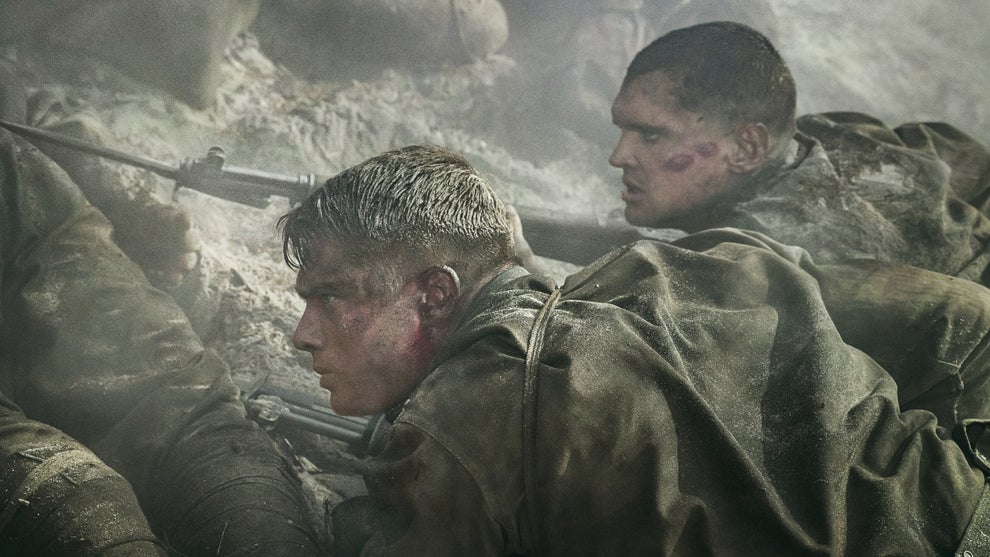
They find themselves in the same Marine Corps regiment throughout the war. They endure a grueling boot camp, followed by shocking violence on the battlefield. Berg, who co-wrote the screenplay with Mark L. Smith (“The Dog Stars”), doesn’t rush to get to the Mosquito Bowl part of his Mosquito Bowl movie. He takes time to introduce his characters, even though they aren’t presented as deep individuals, so we get the gist right away. He also makes the “war” part of the war so overwhelming that the sporting elements fade away for large chunks of the film. As they should. Once you accidentally pick up your friend’s severed head instead of a helmet, the big college game you fumbled doesn’t seem terribly important anymore.
Except it is important, apparently, and “The Mosquito Bowl” keeps coming back to the idea that these men are football men, through and through. Years go by, and not even Bob Hope can rouse these guys’ spirits. Only a good old-fashioned pigskin parlay can do that. Berg presents the actual Mosquito Bowl as a brief, welcome respite, and not just from the war but from the wretched forms of masculinity that thrive on the battlefield. Early scenes depict football as an aggressive obsession, maybe even a childish one, but it’s a healthier outlet for macho male urges than collecting the skulls of the people you’ve murdered.
Whether you love football, hate football or simply don’t understand football, that’s a message we can all get behind: playing football is, indeed, better than fighting a war. Although Berg gets extremely distracted by the armed conflict and seems eager to outdo “Saving Private Ryan,” he never lets the war look like it’s worth fighting. It’s ugly, it’s cruel, and the violence is vomitous. Jacques Jouffret’s cinematography is attractive in a vacuum, but it’s a gauntlet in context. And if I had the space to list every single human being involved in the sound mix, I would, because their work is immersive to the point of inducing terror.

“The Mosquito Bowl” makes heavy-handed points, but those points aren’t subtle, so the approach is appropriate. Unfortunately, that simplicity trickles down to the actors, who have talent to spare but limited space in which to ply their trade. Galitzine is a standout performer in almost every ensemble, except this one. Although his face is recognizable, his stage presence is so absent that it’s a little hard to believe it’s really him. Skarsgård and Francis have precious little to work with but make it work anyway. It’s Nicholson who stands out as a man with well-earned swagger, a movie-star quality that sometimes evokes fond memories of his father, Jack, without making the young actor look like a carbon copy. Nicholson never peacocks, even when his character is flashing his glorious feathers, and that’s charisma at work.
Berg’s film was, like many World War II movies, made for dads. Or perhaps it’s more accurate to say it was made for grandfathers. But while films like this year’s “Pressure” were made for lazy armchair Sundays, “The Mosquito Bowl” was designed to get your parental units out of their chairs and screaming. Hurray for America, boo for nonwhite people, apparently, and what are all these pesky womenfolk doing here?
Those elements are arguably endemic to the era and the genre, but for non-dads and non-grandpas, they inspire less enthusiasm. “The Mosquito Bowl” does what it sets out to do and can technically be called a success, but unless you’re in the target demo, it’s hard to get excited about how much certain parts of this movie totally bite.
“The Mosquito Bowl” opens theatrically on Oct. 30, before its debut on Netflix on Nov. 25, 2026.
