
Budgets are always tough no matter their size.
You’re always trying to do more with what you have and it never goes as far as you’d like it to go.
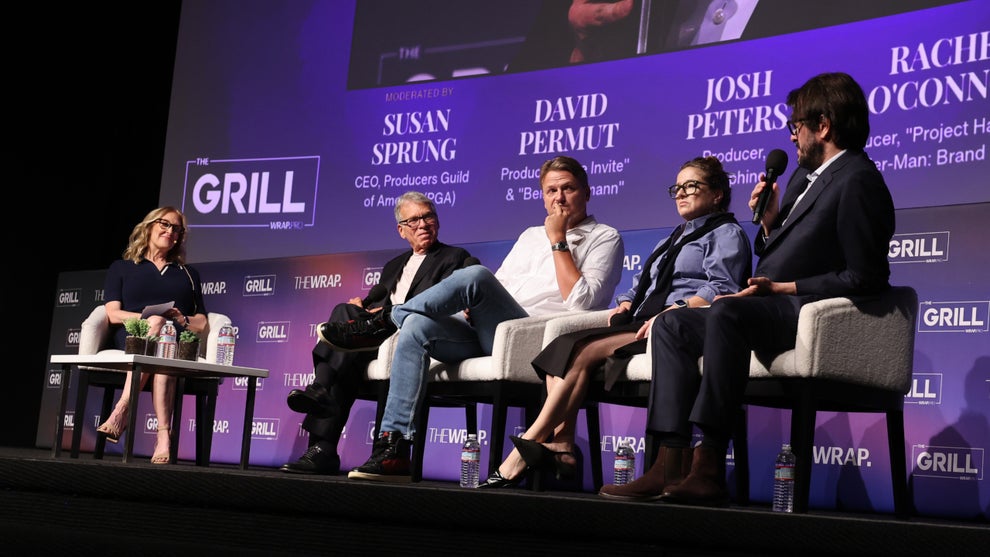
Susan Sprung, CEO of the Producers Guild of America, posed the question of budgets to a group of producers with movies of every size and shape – David Permut, who produced Olivia Wilde’s A24 favorite “The Invite;” Josh Peters, who produced the buzzy Sundance breakout “Josephine;” Rachel O’Connor, who produced juggernauts “Project Hail Mary” and “Spider-Man: Brand New Day;” and Rodrigo Teixeira, who produced James Gray’s “Paper Tiger,” which just opened the New York Film Festival – earlier this week at TheGrill 2026, TheWrap’s annual conference that brings industry leaders together to explore some of the biggest topic in the entertainment industry. And each answered the question about budget challenges through their own unique point of view.
Teixeira acknowledged that “budgets of films are increasing” and that this increase “is difficult.” He said that a little over a year ago “Paper Tiger,” now considered an Oscar frontrunner, “was not a reality.” There was a change in the cast (originally the movie was going to be more of a direct follow-up to Gray’s “Armageddon Time,” with actors/characters returning), which required some creative rejiggering, with Teixeira eventually finding a partner that told him, “Cash flow for you if you guarantee it will get made.” “We were able to do it,” said Teixeira. “It’s a hard job but if you don’t love your job, we quit.”
O’Connor, who admitted she was the only one without indie movie experience, she said that she still faced obstacles in getting her films made, even with hundreds of millions of dollars. (“Spider-Man: Brand New Day,” by the way, recently outgrossed “Star Wars: The Force Awakens” to be the most successful film of all time domestically. Thwip!)
“I think one of the most challenging things about film budgets is they’re usually based on what people are willing to give you to make your movie not what your movie actually costs,” O’Connor said. “Even when you have a crazy big amount of money, it’s still not what the script actually costs and what the people who you need to make the movie actually cost.”
Still, she said, part of what being a producer is involves “someone willing to give you an amount of money to make your movie and you make it happen.”
Talk about a superheroic calling.
Peters had a great take on the nature of producing, calling it a “fulcrum between creative ambition and resources.” Sounds about right.
“There’s what your movie costs and then what the market will give you,” said Peters. He said that he mostly makes fairly low-budget movies, with filmmakers making their films in their home cities. It’s a way to revitalize local economies while also maintaining the director’s authorial voice and it is very cool indeed.
The people funding these movies, Peters said, are doing it “because they believe in the project.” Still, he concluded, it’s always “about balancing ambition and resources.”
Permut, the most seasoned producer on the panel, whose career began in the mid-1970s and includes both studio movies (he produced “Face/Off” and a number of projects for Disney’s Hollywood Pictures imprint) and more recent independent fare like “The Invite” and Apple’s upcoming “Being Heumann,” that that a recent common phrase in Hollywood is, “Can you do it for half?”
“The last number of movies I’ve made have been in the independent space. It’s the appetite for the movie and many times it’s the producers that have to make concessions,” Permut said. He said “The Invite” was made for a “very modest budget because everybody shared the same passion.” For “Being Heumann,” there were different challenges because much of the cast was disabled, which required the production to build dressing rooms with wheelchair access (yes, we can take a moment to ask why regular dressing rooms are so inaccessible).
“It depends on the circumstances of the movie and the shifting sands in Hollywood,” Permut said.
For “Hacksaw Ridge,” it took him 17 years to get the movie made. But they finally did. And on budget too.
